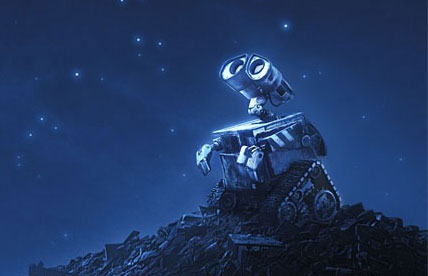
The film opens with what is the opening act's central dichotomy: vast landscapes of trash and ruin contrasted by the sounds of "Hello Dolly." Starting out with the awesome images of a desolated Earth, the film quickly pinpoints the only real creature still alive: a robot, WALL•E. A cleaning robot, to be exact. He roams the planet, or at least a dead metropolis, and compacts all the trash and filth humans deposited many years earlier. In essence, WALL•E lives the film's juxtaposition. Everyday, he cleans up after us while simultaneously being in awe of the peculiarities and idiosyncrasies we left behind, most of all the film "Hello Dolly." In that film and music, he finds the human connection he most wants to replicate: affection. In this dichotomy, Stanton locates both humanity's worst habits and its most profound gifts, art and love.
The first forty minutes are completely absent spoken dialogue save for a few instances of pre-recorded video. Instead, Stanton chooses to create a bit of poetry on the sad state of the planet and the power of images, memories and cinema. The world may be in ruins, but humanity's great past creations live on through WALL•E. Eventually, he meets EVE, a state-of-the-art robot whose function (or "directive" as it is known) is to search and find evidence of life on Earth, sent by the humans light years away. The courtship of EVE by WALL•E is remarkably touching, and as has been noted, inspired in large part by Chaplin's little tramp, and the delicacy of the images bring to mind City Lights.
But eventually, EVE completes her mission by finding a small plant WALL•E has shown her, and the humans come down to pick her up. Desperate to not lose the only other creature he knows (save for his pet roach), WALL•E hitches a ride on the spaceship. Thus begins the second act, where the film becomes something far greater. It is true the beauty and delicacy of the first act are gone, and more broad satire is bourne. But, the film's cluttered, messy vibe is mirroring perfectly the human race's amazing new level of sloth. They have been consumed by the robots and are now complete slaves to the tools they have created.
The latter act's comparisons to 2001: A Space Odyssey are easily spotted, and the film cribs the triumphant Strauss score for the climactic moment of one human's "first step." But, while Kubrick's film was leading us to a complete stripping away of the human form for a new level of existence, Stanton's view is clearly directed at a renewal of humanity, to regain the awareness and thoughtfulness that produced those works of art and compassion so many years ago. The triumphant moment comes as one character exclaims the difference between merely coasting through an existence and physically interacting with the world. Like many great works from artists as varied as Kurosawa to Egoyan, there is a great cautionary tale here to our abuse of technology to supplement actual discovery and connection.
I don't think the film is necessarily at all about some deep dichotomy between robots and humans. The dichotomy for me is the sense of then and now. The sense of connection, creation and love that has over time transferred to robots and has left humans. It seems crucial that the piece of art WALL•E is inspired by is a musical. It has dancing and singing and a strong theme of love. It shows humanity's capacity for both emotion and creation across art forms. It is about hope. That even after humanity has given up and disappeared, there still lives on our ability to care, love, create and sacrifice. And it exists in a peon, an instrument we long forgot about.
But, the film is also, at heart, a simple love story. WALL•E is an unwitting hero, thrown into a battle for the survival of humanity and Earth. At every step, he is driven by a need to hold onto his connection with EVE that itself was generated by humanity's capacity for romance and emotion. His acts of bravery are created by the greatest human trait he has mimicked. It is simple to call him a "Jesus" as his taking on of our sins (cleaning our garbage) and rescuing us from the wallows of our own creation, but that's too simple. The film is fighting against humanity's excess and fighting for its ability to love and care and to create. It dabbles in environmental concerns and big business domination, but at its heart, it is a cry for us to always remember our own individual self and to dream, imagine and create art worth remembering (I love that the closing titles are historically-rendered artwork). And at the center is WALL•E, a robot who is willing to sacrifice it all for love. A sentimental and melodramatic ideal. And also, very human.

No comments:
Post a Comment