Saturday, July 5, 2008

WALL•E: Pixar's futuristic renewal of humanity


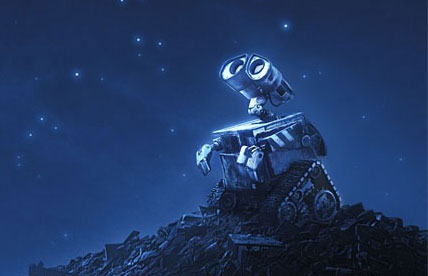
The film opens with what is the opening act's central dichotomy: vast landscapes of trash and ruin contrasted by the sounds of "Hello Dolly." Starting out with the awesome images of a desolated Earth, the film quickly pinpoints the only real creature still alive: a robot, WALL•E. A cleaning robot, to be exact. He roams the planet, or at least a dead metropolis, and compacts all the trash and filth humans deposited many years earlier. In essence, WALL•E lives the film's juxtaposition. Everyday, he cleans up after us while simultaneously being in awe of the peculiarities and idiosyncrasies we left behind, most of all the film "Hello Dolly." In that film and music, he finds the human connection he most wants to replicate: affection. In this dichotomy, Stanton locates both humanity's worst habits and its most profound gifts, art and love.

The first forty minutes are completely absent spoken dialogue save for a few instances of pre-recorded video. Instead, Stanton chooses to create a bit of poetry on the sad state of the planet and the power of images, memories and cinema. The world may be in ruins, but humanity's great past creations live on through WALL•E. Eventually, he meets EVE, a state-of-the-art robot whose function (or "directive" as it is known) is to search and find evidence of life on Earth, sent by the humans light years away. The courtship of EVE by WALL•E is remarkably touching, and as has been noted, inspired in large part by Chaplin's little tramp, and the delicacy of the images bring to mind City Lights.

But eventually, EVE completes her mission by finding a small plant WALL•E has shown her, and the humans come down to pick her up. Desperate to not lose the only other creature he knows (save for his pet roach), WALL•E hitches a ride on the spaceship. Thus begins the second act, where the film becomes something far greater. It is true the beauty and delicacy of the first act are gone, and more broad satire is bourne. But, the film's cluttered, messy vibe is mirroring perfectly the human race's amazing new level of sloth. They have been consumed by the robots and are now complete slaves to the tools they have created.

The latter act's comparisons to 2001: A Space Odyssey are easily spotted, and the film cribs the triumphant Strauss score for the climactic moment of one human's "first step." But, while Kubrick's film was leading us to a complete stripping away of the human form for a new level of existence, Stanton's view is clearly directed at a renewal of humanity, to regain the awareness and thoughtfulness that produced those works of art and compassion so many years ago. The triumphant moment comes as one character exclaims the difference between merely coasting through an existence and physically interacting with the world. Like many great works from artists as varied as Kurosawa to Egoyan, there is a great cautionary tale here to our abuse of technology to supplement actual discovery and connection.

I don't think the film is necessarily at all about some deep dichotomy between robots and humans. The dichotomy for me is the sense of then and now. The sense of connection, creation and love that has over time transferred to robots and has left humans. It seems crucial that the piece of art WALL•E is inspired by is a musical. It has dancing and singing and a strong theme of love. It shows humanity's capacity for both emotion and creation across art forms. It is about hope. That even after humanity has given up and disappeared, there still lives on our ability to care, love, create and sacrifice. And it exists in a peon, an instrument we long forgot about.

But, the film is also, at heart, a simple love story. WALL•E is an unwitting hero, thrown into a battle for the survival of humanity and Earth. At every step, he is driven by a need to hold onto his connection with EVE that itself was generated by humanity's capacity for romance and emotion. His acts of bravery are created by the greatest human trait he has mimicked. It is simple to call him a "Jesus" as his taking on of our sins (cleaning our garbage) and rescuing us from the wallows of our own creation, but that's too simple. The film is fighting against humanity's excess and fighting for its ability to love and care and to create. It dabbles in environmental concerns and big business domination, but at its heart, it is a cry for us to always remember our own individual self and to dream, imagine and create art worth remembering (I love that the closing titles are historically-rendered artwork). And at the center is WALL•E, a robot who is willing to sacrifice it all for love. A sentimental and melodramatic ideal. And also, very human.

Monday, April 7, 2008

Days of Heaven: Malick's Genesis


Everyone already knows the Deuteronomy passage that apparently lent itself to the title of the film. Its reference is to the bountiful days that await the fathers' sons and children as promised by the Lord as they live their lives as if heaven on earth. Of course, this is only a good promise as long as God's children do not stray from his blessings. Once outside the realm of God's love and providence, these days will be brought to the ground and a plague, God's wrath, will be reaped upon the Earth.

So it is that Bill and Abby, lovers playing siblings, should happen upon the land of the farmer. They are on the run from Bill's accidental murder of his foreman back in a Chicago factory. You could say it was the film's original sin, shot in a scene of agonizing fire and sound, muffling the human folly on display. They come to work the farm, to make a living. There is a shot as they enter this land that separates them from the known world: a train passes across an impossible tall bridge set against the sky.


Reason is not directly given for their lie about their relationship, but allow me to point to a different Biblical story: that of Abraham and Sarah. The story goes that as they entered Egypt, Abraham was frightened that if it was discovered such a lovely woman was his wife, he might be murdered and her taken from him. In the film, the lie is used as a means of separating the two characters, allowing for the attraction of the farmer to appear unchallenged. As with Abraham, Bill's own desires and fears drive him to whore his lover off; Abraham for self-preservation, Bill for a dream of no longer living in poverty.

In Genesis, Pharaoh is smitten with Sarah, and takes her for his wife. Therefore he spares Abraham and keeps him on, providing for him as his wife is Abraham's sister. But soon the Lord became angry at Abraham for his deceptions, and afflicted the Pharaoh's land with plagues. Pharaoh became angry at Abraham, questioned him about his relationship with Sarah, and Abraham and Sarah were banished from the land.


The film very much follows this storyline, but the differences, mainly after the farmer's (Pharaoh) discovery of the lie, are key in understanding the film's philosophy as opposed to the Bible's. Malick does not absolve his characters so easily, nor is he as easy to forgive as the Lord. Throughout, the land has looked on unsympathetically, dwarfing the characters in their own purgatory. The majority of the dialogue is the deadpan narration of the 13 year-old younger sister of Bill, played by Linda Manz. It is her conscience that drives the film, and we get the sense that unlike your typical cinematic innocence, she isn't particularly young in her vision of the world. It is likely telling she narrates events she wasn't even present for. Does she intuit, or fully fabricate, the death of the farmer and his realization of the deceit? As she states, "you are half angel and half devil," and she isn't absolved of this.


But then I think of the title and wonder where do I find this? In the middle section? No, here the characters are merely on borrowed time, waiting for the Lord and the land's wrath, waiting for their deception to catch up to them. I believe Malick never shows us these days, but in Linda's final scenes and in her closing dialogue, I think he presents hope, but not the kind God is promising. Rather, it is hope in the unknown and uncertainty of the future. I like to think she is going off to experience the days of heaven, free from the petty and the deception; off to find something of her own.


For years I have berated this film for its muted tones, for its failure to make any of the characters alluring enough to drive its story. But seeing it again, I was wrong. Malick isn't driving a story, but a feeling. The characters feel like mere images and specks against the lanscape of nature. They are objects of confusion. Nature is easier, it doesn't lie or cheat. Late in the film, Linda comments on people along the shore that "it was far off and you couldn't see what they were doing. They were probably calling for help or something--or they were trying to bury somebody or something." People confound, and it is nature that keeps us honest. The plagues that strike the land; Hell's emergence into the serenity; the distance put up between people; the wind's howling at sight of deceit; all these things point to a force simultaneously more complex and yet more simplistic than humanity.


I am amazed that Malick was allowed two years to edit this. I think it really shows in the end result. The flow of the film feels so perfect. Unlike both of his two recent films, both of which are still amazing works, there isn't any fat to this film nor does anything seem to repeat itself. Where in his two recent films everything feels very elliptical, here I would say it is much more forward. He was able to craft the exact film he wanted, and I am fascinated that he took lengthy scenes of dialogue and excised practically all of it. The scenes featuring dialogue exist in two forms: short, brief moments and moments completely drowned out by the peripheral noise, typically machines (man's own inventions stifling his expression?). Those short moments barely even register, and I can just see the image of Malick and his editor sitting in a room and keeping only the necessary dialogue to drive forward the plot while allowing practically all emotion to be reflected in the landscapes and visuals. It only furthers Malick's natural inclination as a very ephemeral director, his temporal decisions often are guilty of eavesdropping, so to speak. In this way, he is similar to a director like Altman in that he is more an artist who does not construct scenes as much as he does moments, floating in and out of conversations, and sometimes these moments float in midair, detached from the surrounding moments. The scenes inside the farmer's bedroom feel particularly isolated, and it seems no coincidence they are almost always shown with an establishing shot from outside the mansion with the light of the room sitting above the earth almost like an angelic loft. I think I'm already beginning to consider this Malick's masterpiece.

In the end, God forgave Abraham, but Malick, and in particular Linda, do not forgive Bill. His death shows him attempting to save himself, leave them behind. When he is shot, Linda can only quip "Nobody's perfect." Indeed, we have all sinned, but some of us can look to the future, and can offer a prayer or thought about others. Linda's caring thoughts to the farmer's death show her as being compassionate beyond the rest of the petty characters. And he final lines, "I was hopin' things would work out for her. She was a good friend of mine," give her and the film a warmth and intimacy almost completely missing before. The future looks brighter indeed.